
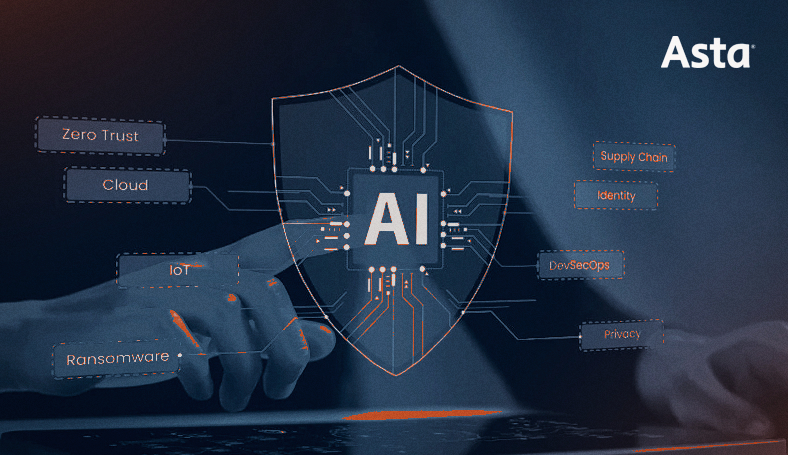
Every day, companies of all sizes face new challenges in protecting their data, infrastructure, and operations. Artificial intelligence (AI) has emerged as one of the most powerful tools for strengthening business cybersecurity. But how does this technology actually work when applied to security? And why is it becoming a key component of corporate protection strategies?
From Reactive Detection to Proactive Prevention
For many years, IT security systems were based on fixed rules and blacklists. In other words, they reacted to already known threats. If a virus, for example, was not listed in a database, it could go undetected. This left companies exposed to next-generation attacks or variants designed to evade traditional systems.
Artificial intelligence changed this paradigm. Thanks to its ability to analyze large volumes of data in real time and learn from behavioral patterns, AI can detect anomalies that could indicate a threat, even if it hasn’t been previously recorded. This proactive approach helps anticipate attacks and respond more quickly.
What can AI do for corporate cybersecurity?
Although AI covers many areas within technology, its role in cybersecurity can be summarized in four main functions:
Behavior-based threat detection
One of the greatest contributions of artificial intelligence is its ability to understand what is considered “normal” behavior within a corporate network. By analyzing data traffic, access, connected devices, and user activity, AI can identify suspicious behavior: an unusual login in the middle of the night, a massive file transfer, or an attempt to log in from an unusual location. All of these can be signs of an attack in progress.
Automated responses
Speed is crucial when it comes to cybersecurity. An attack can compromise an entire network in a matter of minutes. AI not only detects threats but can also automatically act to contain them. For example, you can isolate a compromised device from the network, block an IP address, or alert the security team with specific data about what’s happening.
Predictive Analytics
By analyzing historical data, AI can predict behaviors or vulnerabilities that could be exploited in the future. This allows companies to strengthen their weaknesses before they become a real problem.
Alert Filtering and Noise Reduction
In many traditional security systems, analysts receive thousands of alerts daily. Many of these are false positives or minor events that don’t require intervention. This creates fatigue and can lead to overlooking a real threat. AI helps filter these alerts, prioritizing the most relevant ones and freeing up time for professionals to focus on what’s truly important.
Real-World Application Cases
Companies around the world are already integrating AI solutions into their cybersecurity systems. From platforms that protect financial services to hospitals that safeguard sensitive patient information, AI is present in sectors where security cannot fail.
In many organizations, artificial intelligence is used alongside tools such as SIEM (Security Information and Event Management) and SOAR (Security Orchestration, Automation, and Response) to create more resilient and adaptable environments. These technologies not only detect and respond to threats, but also continuously learn from each incident to improve their capabilities.
The Challenges of Artificial Intelligence in Cybersecurity
Although the benefits of AI are indisputable, there are also significant challenges. One of them is data quality: for an AI system to function properly, it needs clean, relevant, and up-to-date data. If the training data is incomplete or biased, the results can be unreliable.
Furthermore, implementing AI-based systems requires adequate technological infrastructure and trained personnel to manage it. It’s not simply a matter of purchasing a solution and activating it: it must be integrated into the overall cybersecurity strategy and constantly monitored.
It’s also important to keep in mind that cybercriminals, in many cases, are also beginning to use AI to refine their attacks. This creates a kind of “technological race” in which both attackers and defenders seek to stay one step ahead.
Is your company ready to incorporate AI into its security?
Adopting artificial intelligence in your cybersecurity strategy is not a question of whether, but when and how. In a constantly changing and evolving digital environment, having tools capable of adapting and anticipating threats is key to protecting a company’s most valuable assets: its information, its reputation, and the trust of its customers.
At Asta, we help organizations integrate artificial intelligence solutions strategically and securely. We assess the current state of your infrastructure, design a customized plan, and work with you to ensure a successful implementation that enhances your response capacity to any threat.
Conclusion
Artificial intelligence is no longer a promise of the future: it is a reality that is redefining the way companies protect themselves in the digital world. Its ability to proactively detect threats, automate responses, and filter out information noise makes it an indispensable ally in the fight against cyberattacks.
Integrating it intelligently can make the difference between reacting too late or avoiding the impact of a serious incident. In the new digital age, security needs to evolve, and AI is one of its main tools.
About Our mission in the digital space
Asta is a leading full-service technology and consulting agency. We’re trusted industry leaders, who are committed to advancing businesses through powerful IT. Yet, beyond our IT acumen in software, web and mobile app development, our fit-for-purpose managed IT service solutions and our ground-breaking AI and blockchain technologies – there’s something more.
At the core of everything we do is our relentless commitment to people.
Contact and social networks
Contact us through our available means, and a specialized advisor will contact you to resolve all your questions: